Digital Gardens
Digital Gardens. What they are and why create one
aka notes/second-brain and related to notes/personal-knowledge-management
What is a digital garden?
https://maggieappleton.com/garden-history is excellent (and lengthy)
She distills these design principles as demarcating digital gardens (we've taken the one's we think are most relevant):
- Topography over Timelines: Gardens are organised around contextual relationships and associative links; the concepts and themes within each note determine how it's connected to others. This runs counter to the time-based structure of traditional blogs: posts presented in reverse chronological order based on publication date.
- Continuous Growth: Gardens are never finished, they're constantly growing, evolving, and changing. Just like a real soil, carrot, and cabbage garden. This isn't how we usually think about writing on the web. Over the last decade, we've moved away from casual live journal entries and formalised our writing into articles and essays. These are carefully crafted, edited, revised, and published with a timestamp. When it's done, it's done. We act like tiny magazines, sending our writing off to the printer.
- Imperfection & Learning in Public: Gardens are imperfect by design. They don't hide their rough edges or claim to be a permanent source of truth. Putting anything imperfect and half-written on an "official website” may feel strange. We have all been trained to behave like tiny, performative corporations when it comes to presenting ourselves in digital space.
Maybe's
- Playful, Personal, and Experimental: Gardens are non-homogenous by nature. You can plant the same seeds as your neighbour, but you'll always end up with a different arrangement of plants.
- Intercropping & Content Diversity: Gardens are not just a collection of interlinked words. While linear writing is an incredible medium that has served us well for a little over 5000 years, it is daft to pretend working in a single medium is a sufficient way to explore complex ideas. It is also absurd to ignore the fact we're living in an audio-visual cornucopia that the web makes possible. Podcasts, videos, diagrams, illustrations, interactive web animations, academic papers, tweets, rough sketches, and code snippets should all live and grow in the garden.
- Independent Ownership: Gardening is about claiming a small patch of the web for yourself, one you fully own and control. This patch should not live on the servers of Facebook, LinkedIn, Twitter, Instagram (aka. also Facebook), or Medium. None of these platforms are designed to help you slowly build and weave personal knowledge. Most of them actively fight against it.
Why now?
New-fangled graph-oriented knowledge systems seem all the rage e.g. Roam and now a plethora of others Foam, Dendron, Obsidian, Athens Research etc etc (though seem incredibly similar to wikis … but with backlinks and block level linking …)
These enable digital gardening much more easily.
We could think of this as wiki 2.0 (or may be wiki 3.0 if mediawiki was 2.0!)
From https://maggieappleton.com/garden-history
What made our current historical moment the right time for digital gardening to take off?
The timing coincided with a few complimentary ideas and communities rallying around personal knowledge systems, note-taking practices, and reimagining tools for blogging. The scene was ripe for new ideas around curating and sharing personal knowledge online.
Many of the people who jumped on the early digital gardening bandwagon were part of communities like…
- The IndieWeb collective – a group that has been championing independent web spaces outside the walled gardens of Instatwitbook for nearly a decade.
- Users of the note-taking app Roam Research – Roam pioneered new ways of interlinking content and strongly appeals to people trying to build sprawling knowledge graphs.
- Followers of Tiago Forte's Building a Second Brain course which popularised the idea of actively curating personal knowledge.
- People rallying around the Learn in Public ethos that encourages continuously creating 'learning exhaust' in the form of notes and summaries.
References
- https://github.com/MaggieAppleton/digital-gardeners - Resources, links, projects, and ideas for gardeners tending their digital notes on the public interwebs - 💬 good listing of digital garden resources
- https://github.com/KasperZutterman/Second-Brain - A curated list of awesome Public Zettelkastens 🗄️ / Second Brains 🧠 / Digital Gardens 🌱
Examples
- Process https://twitter.com/Mappletons/status/1250532315459194880 ✅2022-05-29 see list just below
- https://github.com/KasperZutterman/Second-Brain
List from twitter.com/Mappletons/status/1250532315459194880
- https://maggieappleton.com
- looks pretty nice
- screenshotted
- includes tech backend which is great https://github.com/MaggieAppleton/maggieappleton.com-V2
- Buster Benson's "Piles" and "Codex" @buster https://notes.busterbenson.com -
- interesting site. Theme is pretty raw. Lots of interesting rationalist ideas (seems to be a theme in this space!)
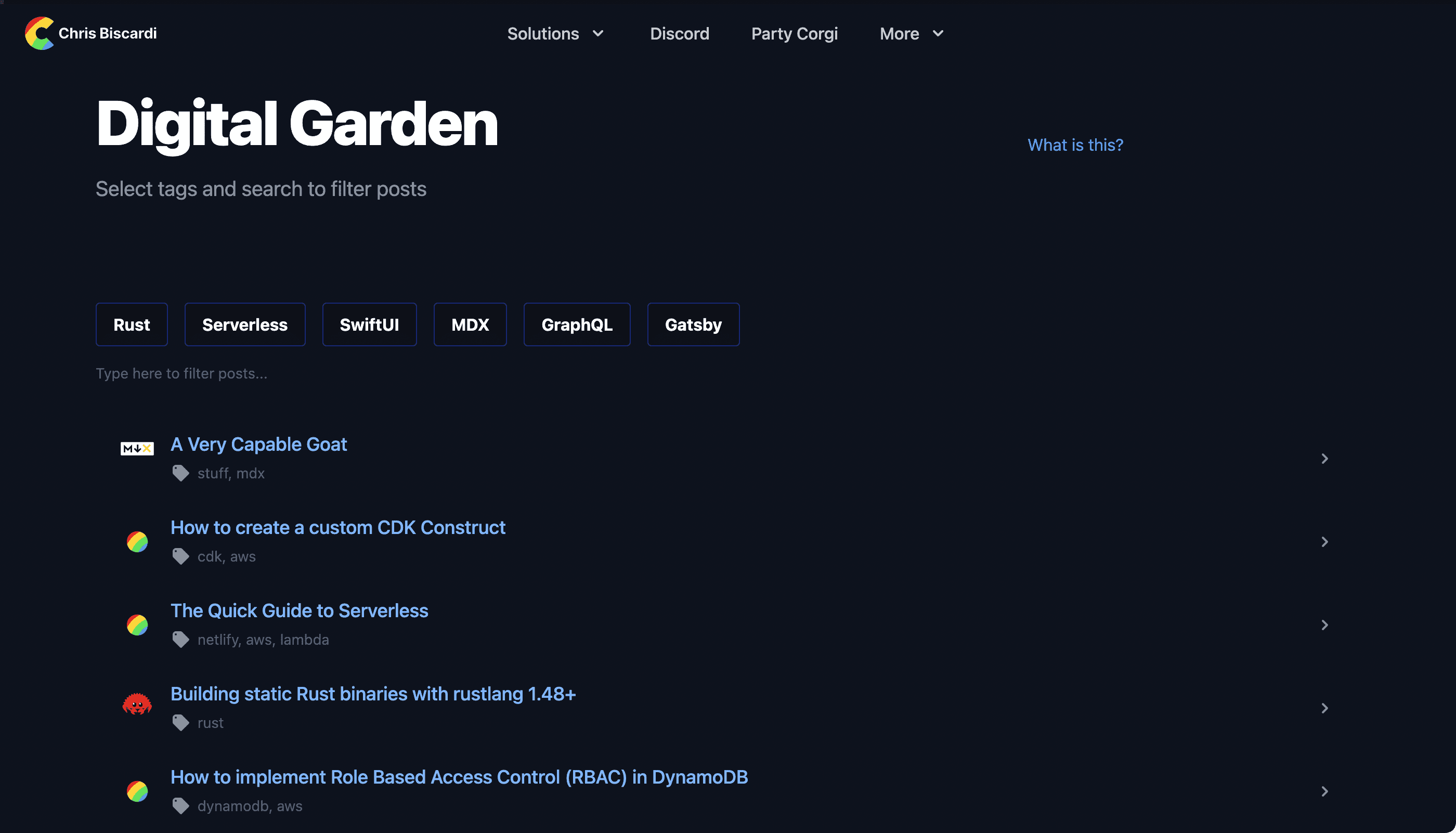
- 4. @chrisbiscardi's Digital Garden (rainbow style!) https://www.christopherbiscardi.com/garden
- nice-ish theme. quite simple structure and content (mainly dev oriented)
- Screenshotted
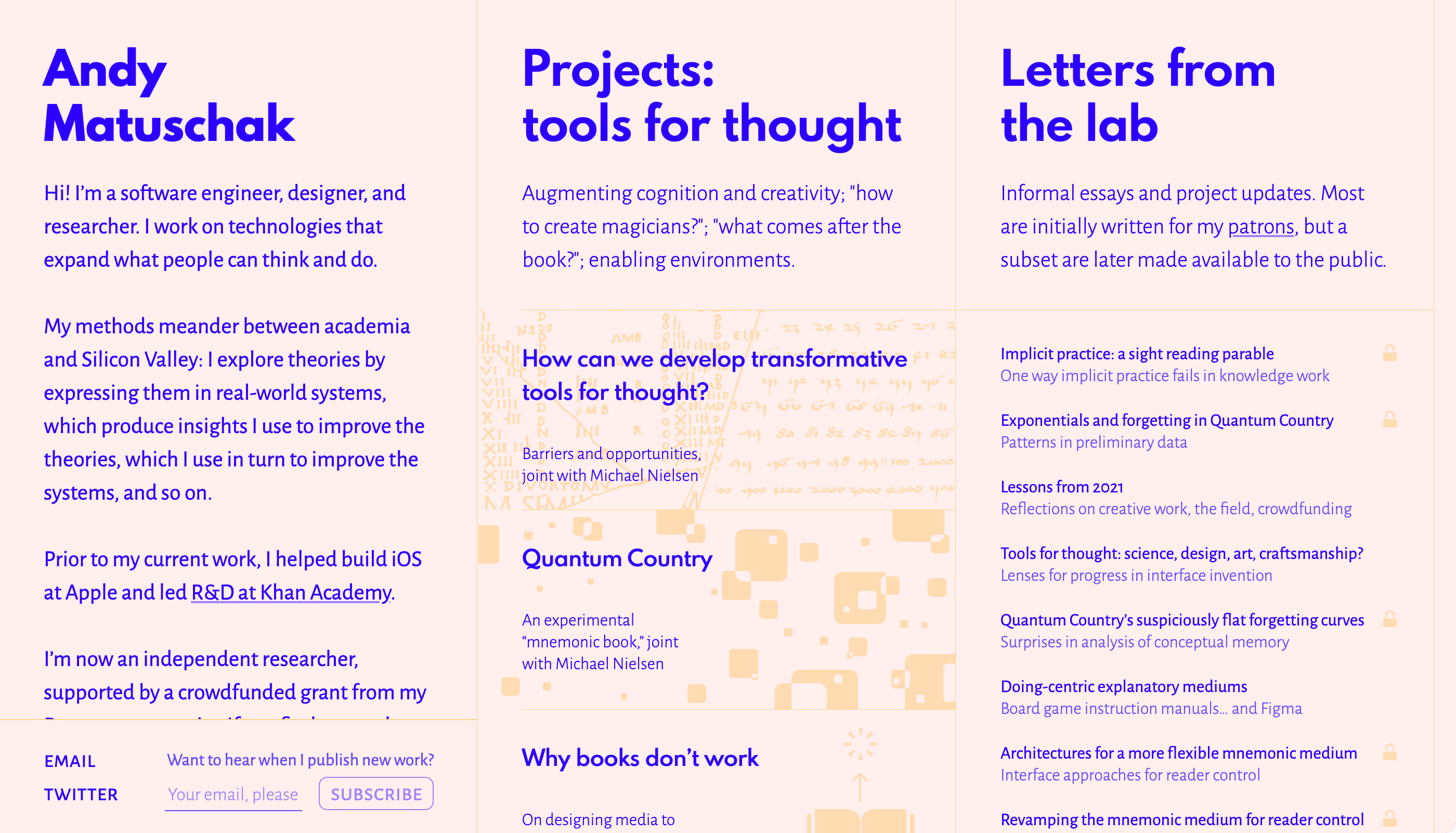
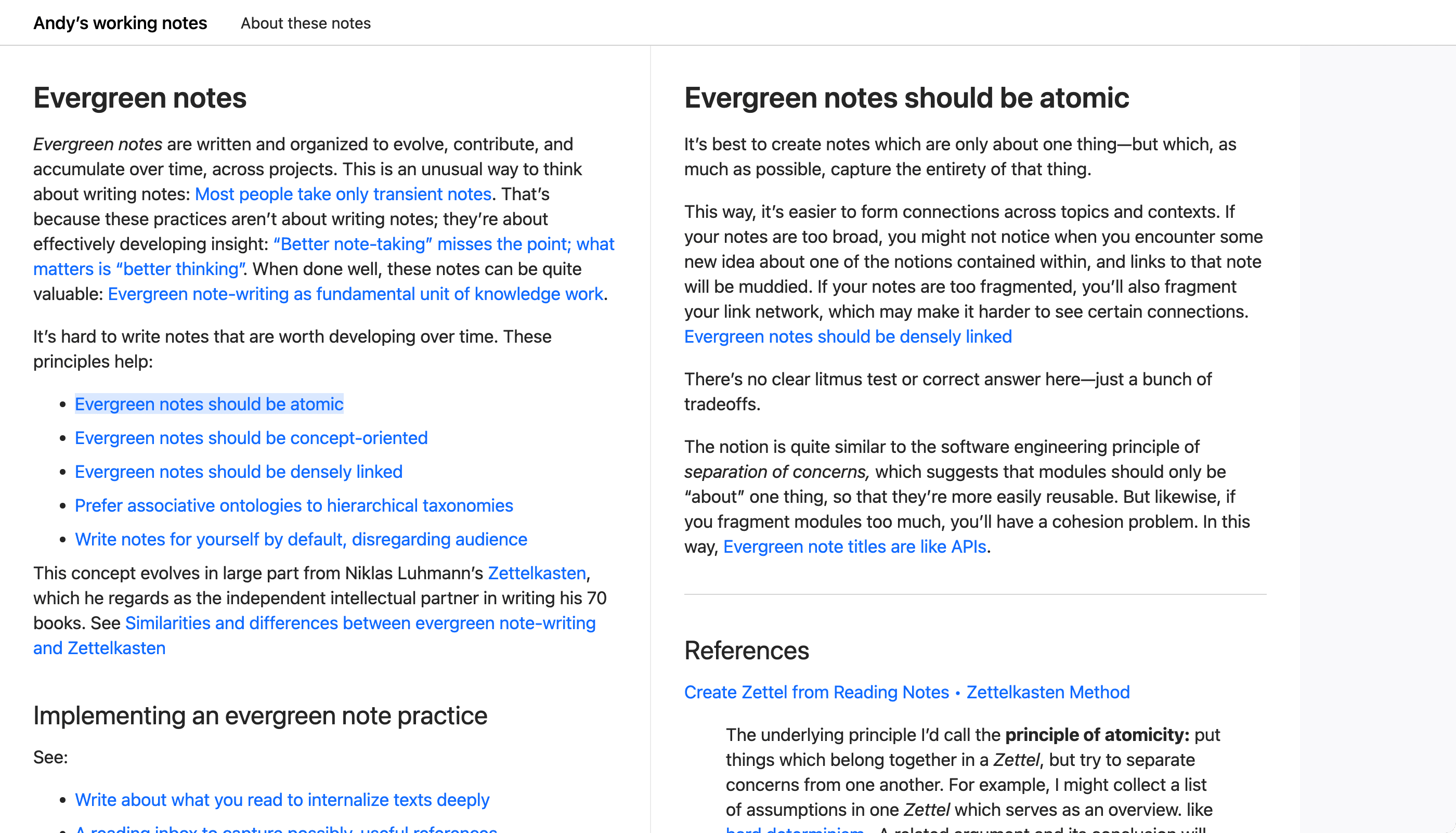
- 5. @andy_matuschak's layered, bi-directionally linked system of "Evergreen notes" https://notes.andymatuschak.org/
- a classic and very good example with very rich content.
- Screenshotted
- 8. @wynlim's thoughts on Designing a Self-directed Learning Network: https://winnielim.org/experiments/learning/designing-a-self-directed-learning-network-work-in-progress-v0-1/ - https://winnielim.org/notes
- like the reflections and the sketches (very elegant). Site theme is simple and black … and nothing too significant to take from it.
- 9. @jhooks manifesto on Digital gardens > blogs: https://joelhooks.com
- simple nice text but nothing special in the design side https://joelhooks.com/digital-garden
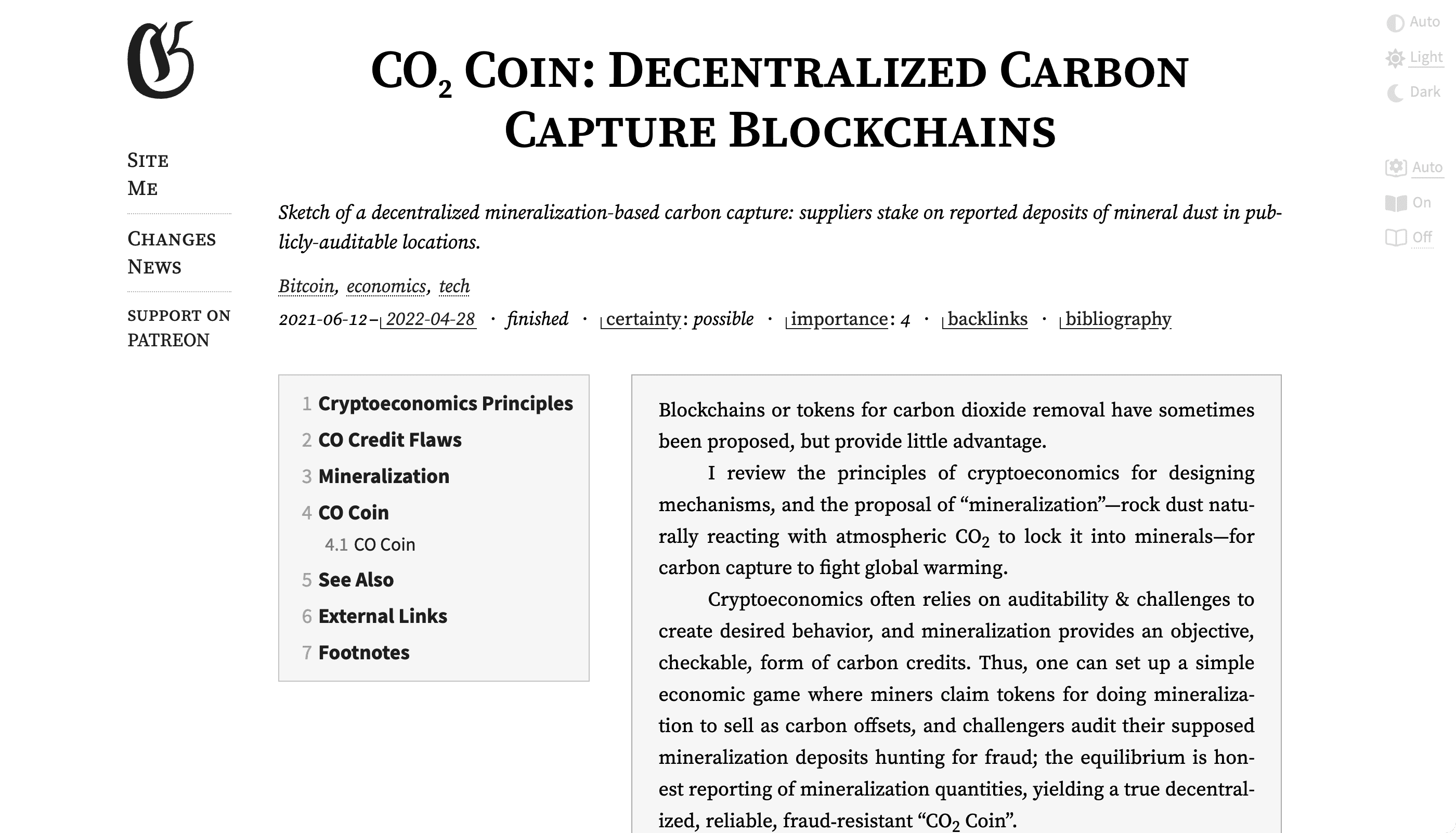
- 10. @gwern's sprawling, info-packed wiki with hover previews, TOCs, and a public change log https://www.gwern.net
- Think content is … very thorough etc … not sure i especially like the theme which is a bit serif-y for my tastes. notes another abc/ea-rationalist
- screenshotted
Notable features
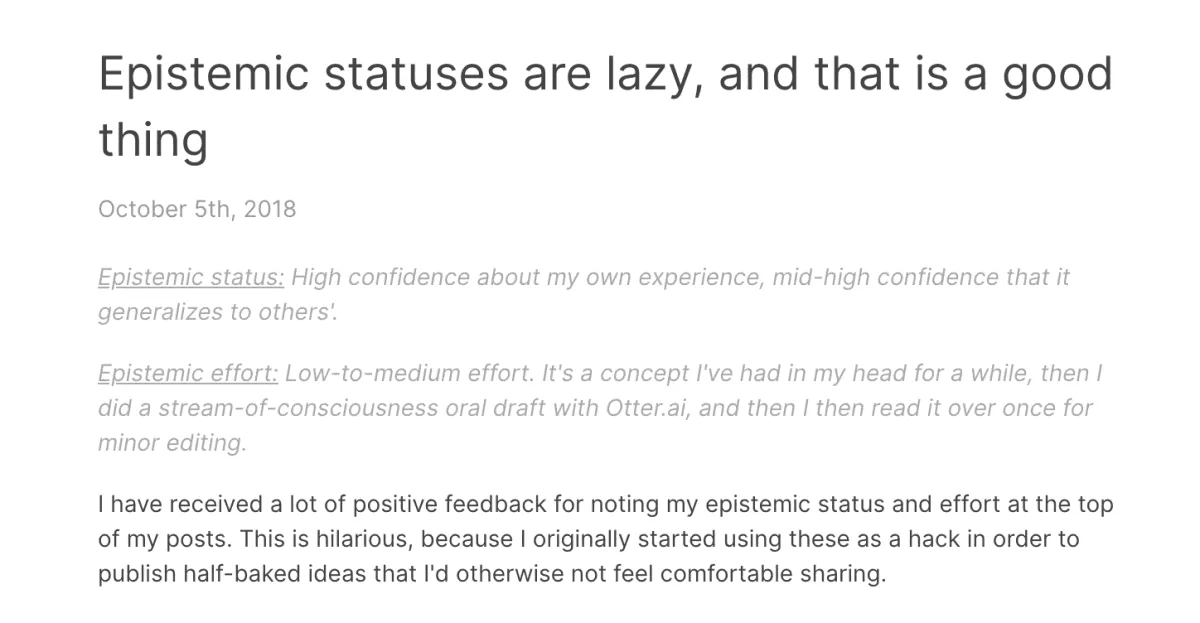
Epistemic status
https://devonzuegel.com/post/epistemic-statuses-are-lazy-and-that-is-a-good-thing
Guess what: definitely abc/ea-rationalist
Themes
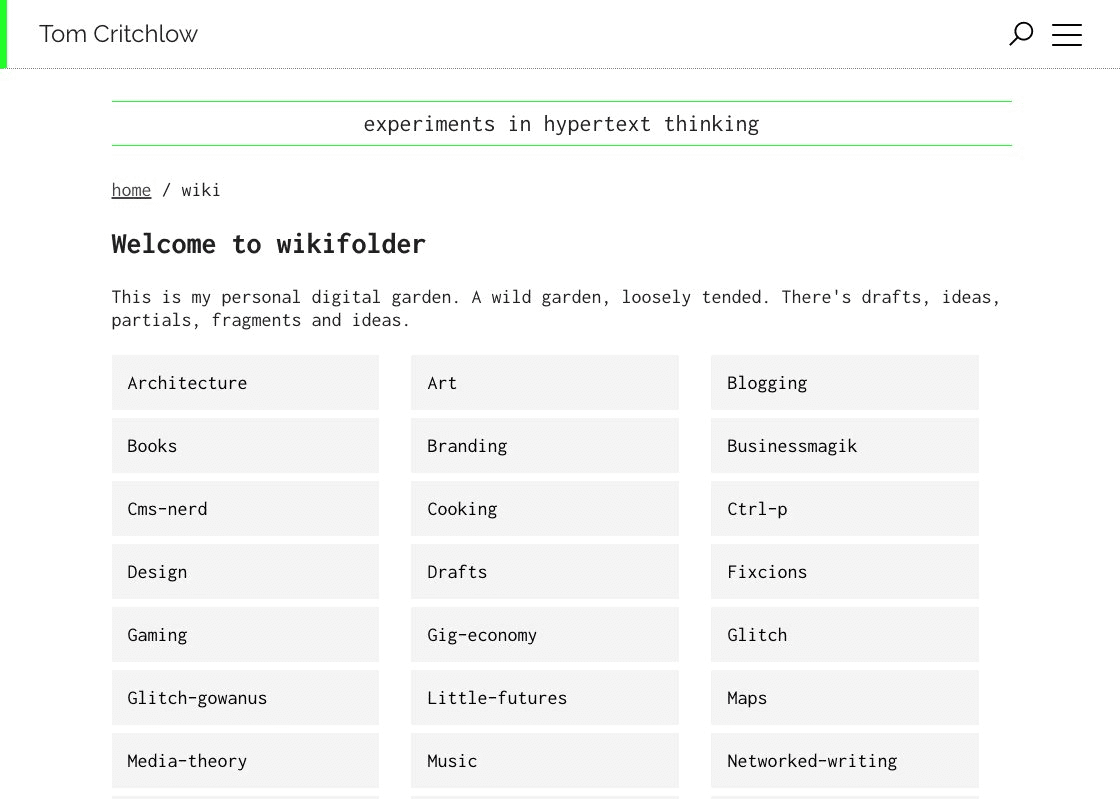
Ranking: best so far is tomcrictchlow
https://tomcritchlow.com/wiki/
Generally a very elegant website.
https://www.christopherbiscardi.com/garden
https://andymatuschak.org
gwern.net