Rufus Pollock
Founder of Open Knowledge Foundation and Datopian.
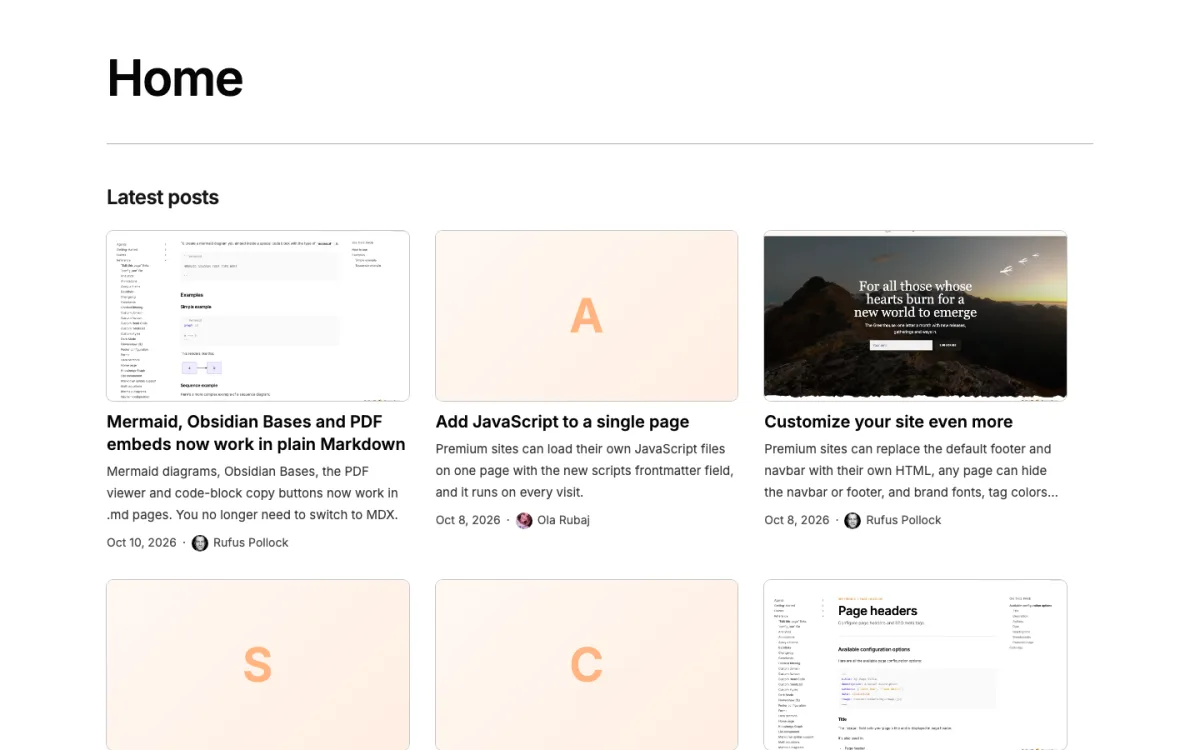
Turn a folder of Markdown pages into a blog index, a grid of projects or a team page on Flowershow, with no code: a folder name or one line of frontmatter.
Give it this page as Markdown: https://flowershow.app/blog/listing-pages-tutorial.md. Or install the Flowershow skill so it knows how to build listing pages for you: tell your agent "Install the Flowershow skill from https://raw.githubusercontent.com/flowershow/skills/main/SKILL.md" (more options in Skills). The whole site is indexed at https://flowershow.app/llms.txt.
You have a folder of pages (posts, projects, people) and you want a page that lists them: a blog index at /blog, a portfolio at /projects, a team page at /team. On Flowershow the folder does most of the work. A blog/ folder lists itself, and any other folder's README.md becomes its index with one line of frontmatter.
(If you only want a few items inside another page, like your three latest posts on the home page, see Show a list of pages anywhere: it's one block.)
Three index pages, each made from a folder of ordinary Markdown pages:
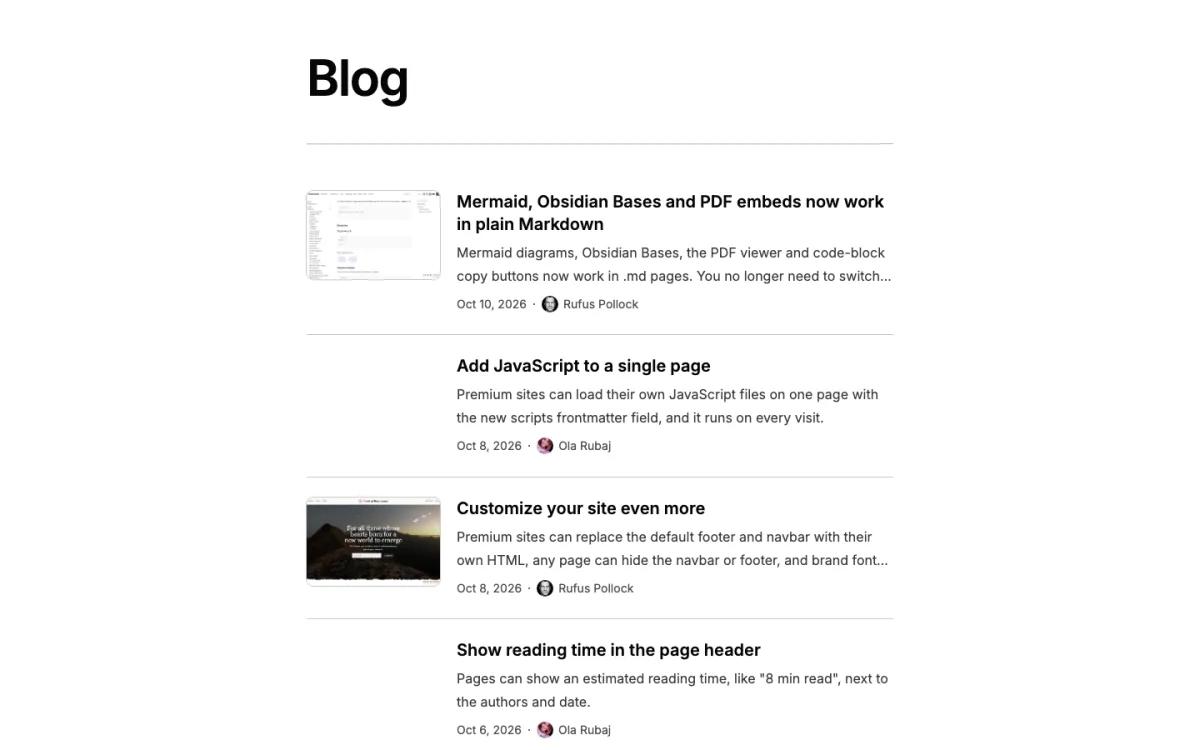
/blog: every post, newest first, 20 per page. The blog you're reading is one: flowershow.app/blog.
/projects: a grid of cards with cover images.
/team: portraits with names, roles and short bios. Here is a live one, listing the people/ folder of this site:Founder of Open Knowledge Foundation and Datopian.
Core builder of the app, publishing, tooling and docs.
Flowershow developer, and loves bees.
You'll learn that a folder of pages is all a listing needs, how layout: list turns a folder's README.md into its index, and how view changes the look.
You'll need: a Flowershow site you can add files to and publish. Time: about 15 minutes.
blog/ folderCreate a folder called blog at the top of your site and put your posts in it, one Markdown file each:
blog/
  notes-from-the-garden.md
  first-frost.md
Give each post a title, a date and, if you like, a description and an image. For example, blog/notes-from-the-garden.md:
---
title: Notes from the garden
description: What worked this year, and what the slugs ate.
date: 2026-10-11
image: "[[garden.jpg]]"
---

The tomatoes did better than expected...
Publish, then open /blog on your site. You should see an index of your posts, newest first, titled "Blog", even though you haven't written an index page. A folder named blog or posts (at any depth) lists itself, unless its README.md decides for itself (for example, it has a layout, its own list or Bases block, or list: false).
Create blog/README.md with a title and a sentence or two, and nothing else:
---
title: Blog
---

Notes on compilers and gardening, roughly weekly.
Publish and reload /blog. You should see your intro, then the same list of posts under it.
layout: listFolders with other names don't list themselves; you tell them to. Create a projects/ folder with one page per project, for example projects/seed-library.md:
---
title: Seed library
description: A lending library for heritage vegetable seeds.
image: "[[seed-library.jpg]]"
---
A project can also be a folder of its own (projects/seed-library/README.md, with its images beside it); it's listed as one item.
Then create projects/README.md:
---
title: Projects
layout: list
list:
  view: grid
---

Things I'm building, or have built.
layout: list makes this page the index of its own folder. view: grid under list: turns the rows into cards. Publish and open /projects. You should see a grid of cards (pages without a date are sorted by title): three across on a wide screen, two on a tablet, one on a phone. If some projects have an image and others don't, the others get a tile with their first letter, so the rows stay lined up.
view: peopleCreate a team/ folder with one page per person (team/ada.md, team/grace.md). Each page has the person's photo, role and a short bio, for example team/ada.md:
---
title: Ada Lovelace
avatar: "[[ada.jpg]]"
role: Analyst
bio: Wrote the first published program, for a machine that was never built.
---
Then create team/README.md:
---
title: Team
layout: list
list:
  view: people
---
Publish and open /team. You should see square portraits with each person's name, role and bio, sorted by name. Someone without a photo gets their initials.
That's the whole pattern: a folder of pages, plus a README.md with layout: list and, if you want, a view.
blog/README.md already links to every post, and now there's a second list under it. Add list: false to its frontmatter.draft: true or publish: false are left out, and so is the folder's own README.md."limit" shows only the first 5 items and hides the rest. A key is wrong; the message says what to use. On a layout: list page, use pageSize (items per page), not limit.team.md with a table, and it can't be listed. A listing shows one page per item: give each person their own page.date (or, if it has none, pubDate, published, publishDate, created, or a YYYY-MM-DD at the start of the file name). Undated pages go last.Each of these is one or two lines under list:; the Listing pages reference has every key and default.
sort: title and fields: { date: none }.order: 1, order: 2 and so on, and add sort: order (as the live team list above does).archive.md with layout: list and list: { from: blog, view: compact }.featured: 1.group: year, or group: status for projects.fields, e.g. eyebrow: category or meta: [status].--list-card-radius in your custom.css; see Styling.<List />? What changed and how to switch: the listing pages changelog entry and Coming from the List component. Flowershow