Listing pages
A blog index, a grid of projects or the latest posts on your home page, from any folder, in plain Markdown.
Everything on this page is fenced blocks and frontmatter. You don't need MDX or components, and it works the same in .md and .mdx pages.
A blog with nothing to write
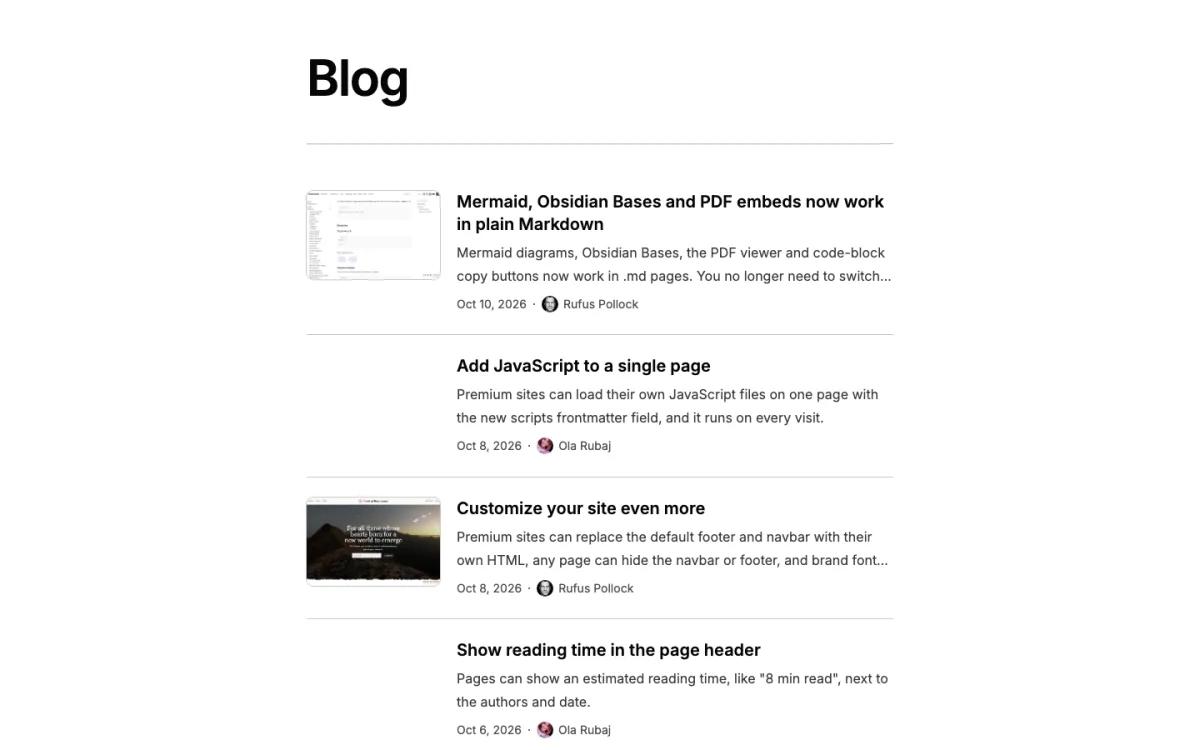
A folder named blog or posts (any case, at any depth, so /notes/posts counts too) lists itself:
- No
README.mdorindex.mdin the folder:/blogshows every page in the folder and its subfolders, newest first, 20 per page, titled after the folder ("Blog"). - A
README.md(orindex.md) with only prose: the list appears under your prose. - An Obsidian folder note (
blog.mdbesideblog/) with only prose: the same, the list appears under the note.
Pages that already decide for themselves are left as they are: any page with a layout, and any page that already has a list block, an Obsidian Bases block or embed (![[Posts.base]]), a <List /> component or an <ObsidianBasesViews /> component.
If your blog/README.md links to its posts by hand and you don't want a second list under it, add list: false to its frontmatter:
---
title: Blog
list: false
---
A blog index in one line
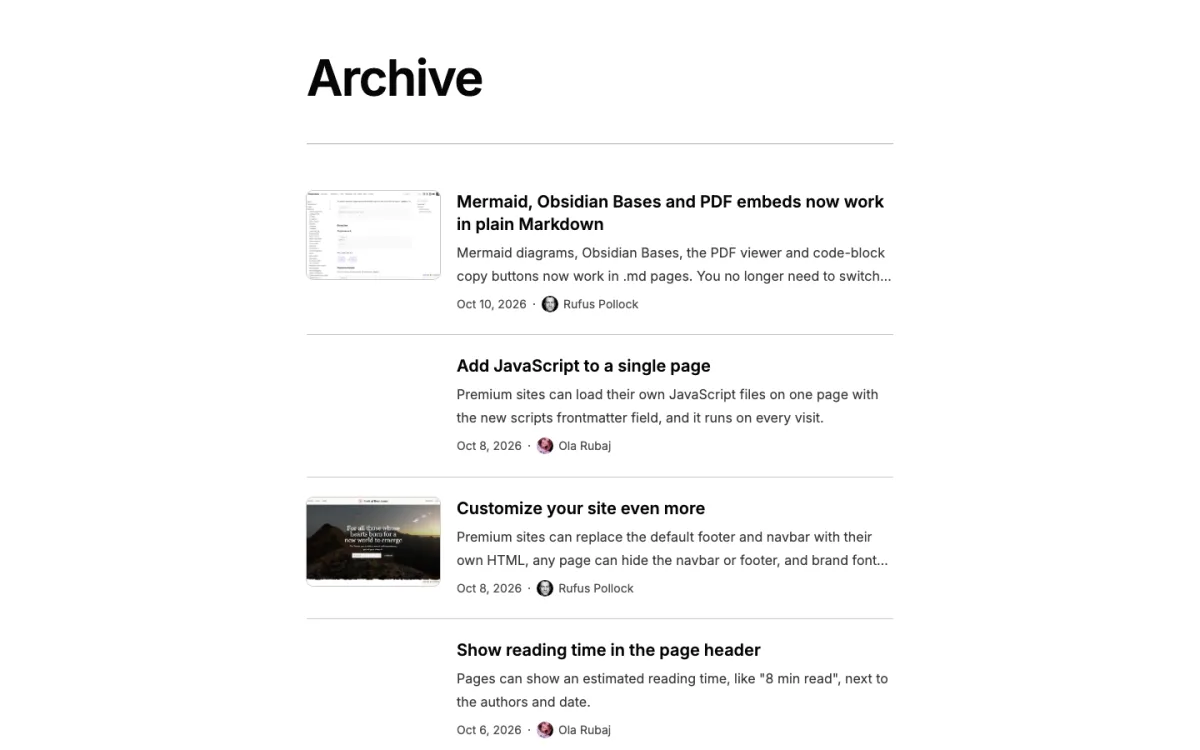
Add layout: list to a folder's README.md to list that folder:
---
title: Blog
layout: list
---

Notes on building things, roughly weekly.
The page shows its title, your intro, then every page in blog/ and its subfolders, newest first, 20 per page, with "Newer" and "Older" links. Each item shows its title, description, image (if it has one), date and authors.
Page-level options go in a list: map in the same frontmatter and use the same keys as a block (see Options):
---
title: Projects
layout: list
list:
  view: grid
  sort: title
---
On an Obsidian folder note (blog.md beside blog/), layout: list lists the sibling folder.
Or put a ```blog block anywhere on any page. It lists blog/:
```blog
```
A ```blog block is a ```list block with from: blog filled in. For any other folder, use ```list and say which one:
```list
from: notes
```
from is relative to the site root (a leading / is optional), or to the page's own folder with ./ (from: ./drafts).
Latest posts on your home page
---
title: Jane Smith
---

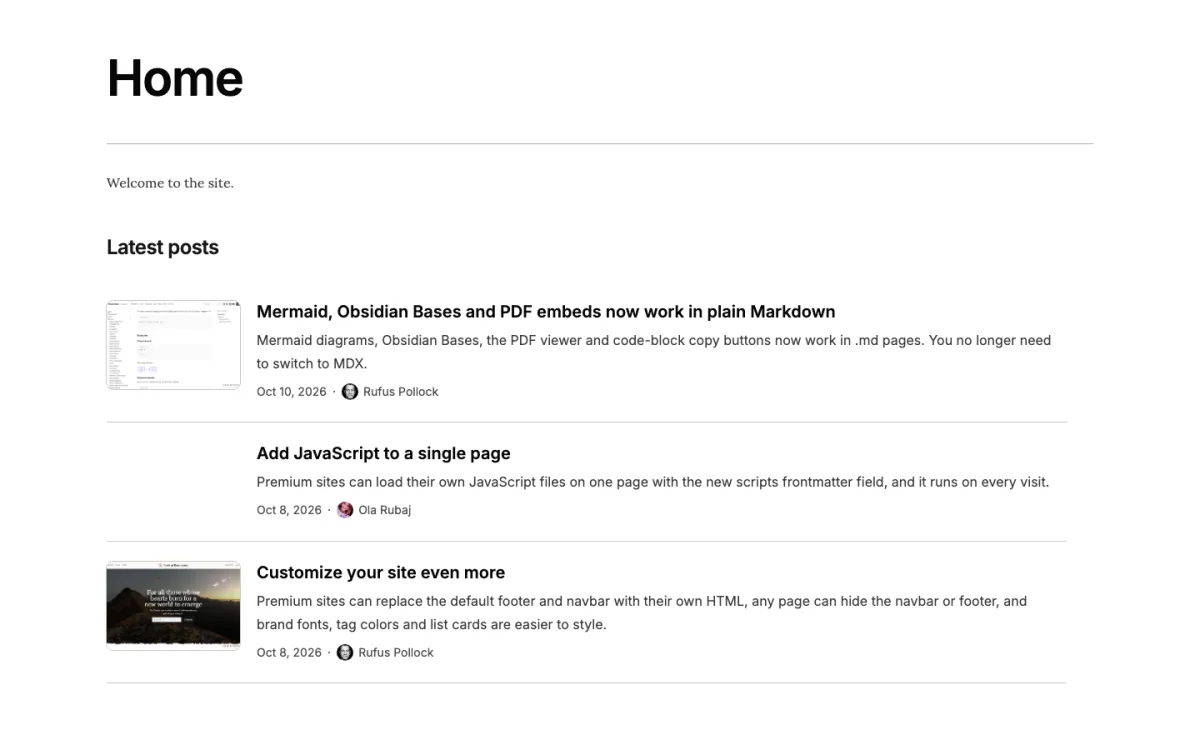
I write about compilers and gardening.

## Latest posts

```blog
limit: 3
```

[All posts →](/blog)
limit shows the first three and never paginates.
Options
Every key works in a ```list or ```blog block and in a list: map on a layout: list page.
| Key | Values | Default | What it does |
|---|---|---|---|
from | folder path | blog for ```blog; the page's own folder for layout: list; required for ```list | The folder to list, including its subfolders. Must be a folder, not a page. |
view | list, grid | list | Rows with a small thumbnail, or a grid of cards. See Views. |
sort | <field> [asc|desc] or -<field> | date desc | Order of items. date means the item's date (see fields). title, path or any frontmatter field. |
limit | number | none | Show at most this many items and never paginate. For teasers. |
pageSize | number or none | 20 on layout: list and zero-config pages; none in blocks | Items per page. A list with neither limit nor pageSize shows at most 200 items. |
where | map of field to value(s) | none | Keep only matching items. See Filtering. |
fields | map of slot to field, or a list | per view | Which frontmatter field fills each part of a card. See fields. |
media | thumb, thumb right, cover, none | thumb in list (on the left), cover in grid | How images are shown: a thumbnail beside the text (left unless you write thumb right), a cover above it, or no images. |
ratio | 16/9, 3/2, 4/3, 1/1, 3/4 | 3/2 for thumbnails, 16/9 for covers | Shape of the image box. 16:9 works too. |
defaultImage | image path, [[wikilink]] or none | unset | Image for items that don't have one, found relative to the listing page. none turns off the letter tiles in a grid (see Views). |
Keys are case-insensitive (pagesize works). A few natural guesses are read silently: dir and folder mean from, layout inside a block means view, cards means grid, sortBy with sortDirection means sort, and sort: -date means newest first.
Choosing what each card shows (fields)
Each card has the same parts: an image, an eyebrow above the title, the title, a summary, and a meta line (date · authors · extra values). By default they come from these frontmatter fields:
| Slot | Default field | If that is missing |
|---|---|---|
title | title | the first # heading, then the file name |
summary | description | the page's opening sentence |
date | date | pubDate, published, publishDate, created, then a YYYY-MM-DD prefix in the file name |
image | image | cover, heroImage, thumbnail, avatar |
authors | authors | author |
eyebrow | none | |
meta | none |
Change only the slots you name:
```list
from: projects
view: grid
fields:
  date: none
  eyebrow: client
  meta: [status]
```
nonehides a slot (the title can't be hidden). Projects usually wantdate: none.eyebrowandmetatake up to two fields each:eyebrow: [date, category]. A field in the eyebrow leaves the meta line, soeyebrow: datemoves the date up.- Naming a field replaces the fallbacks:
fields: { date: published }reads onlypublished. - The list form turns on exactly the named slots:
fields: [title, date, description].descriptionfills the summary,imagethe image,author/authorsthe authors; any other name goes in the meta line.
Authors show as small avatars and names linked to their author pages (see Page authors); a name without an author page is plain text. Wiki links in any field (guests: ["[[Ada Lovelace]]"]) become links. Images can be wiki links or paths relative to the item's own file; only real images (an image file on your site, or an http(s) URL) are shown.
readingTime isn't available in listings yet.
Views
list (the default) is one column of rows. The thumbnail sits on the left; media: thumb right puts it on the right. On a layout: list page the header, intro and list share one reading-width column. A row without an image is text only, lined up with the other rows' text. media: cover shows a wide image above each row's text; media: none gives plain text rows.
grid shows cards in three columns on wide screens, two on tablets and one on phones. A layout: list grid page uses the full content width.
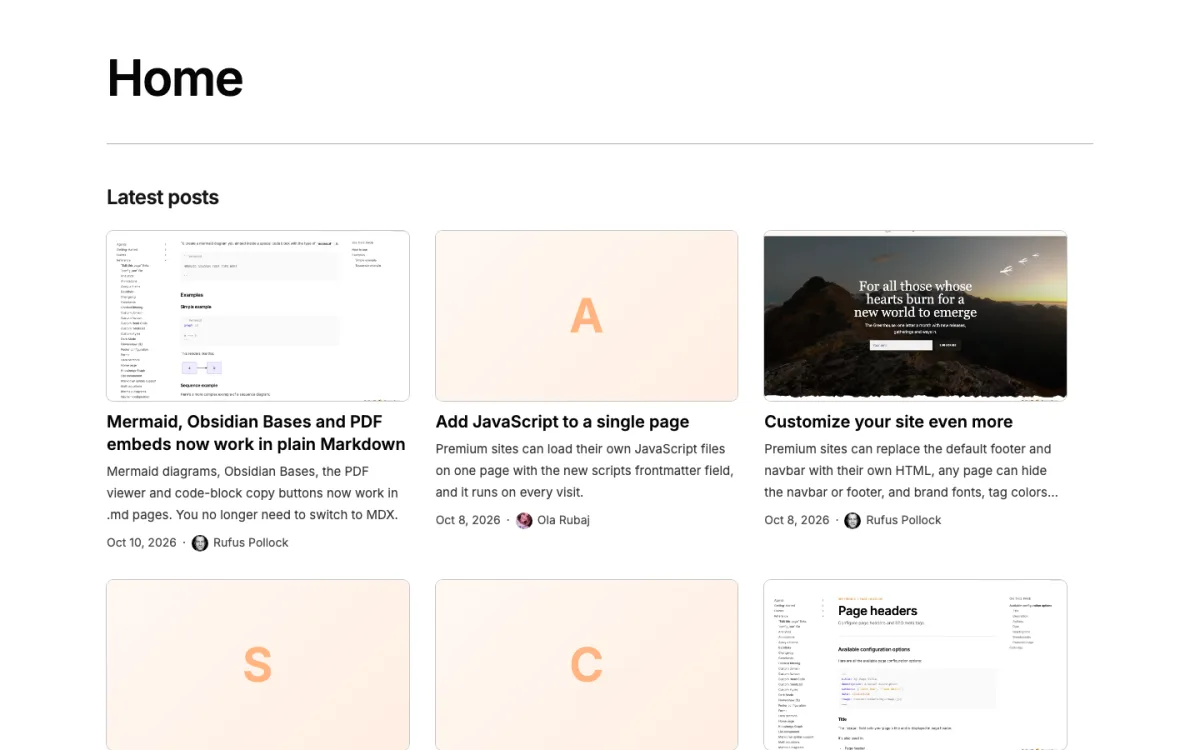
How a grid handles items without an image:
- No item has an image: text-only cards, with no image boxes.
- Some items have images: the others get a tile tinted with your theme's accent colour, showing the first letter of the title, so the rows stay aligned. The tile is decorative (screen readers skip it). On phones, where the grid is one column, the tiles are hidden.
defaultImage: "[[cover.png]]"shows that image instead of the tile.defaultImage: noneturns the tiles off: those cards are text only.
```list
from: projects
view: grid
ratio: 4/3
defaultImage: "[[assets/project-placeholder.png]]"
```
Quote a wiki link value ("[[cover.png]]") to keep it valid YAML in other tools; unquoted works too.
Which pages are listed
A page is listed when it is in the from folder or any folder below it, and:
- it is a
.mdor.mdxpage (not a canvas or an asset); - it isn't the folder's own
README.md/index.md. AREADME.mdorindex.mdin a subfolder is listed, titled after its folder:projects/alpha/index.mdis the item "Alpha", with its images beside it; - it isn't the page the list is on;
- it doesn't have
publish: false; - it doesn't have
draft: true.
A draft stays reachable at its URL (so you can share it for review) but is left out of list blocks, layout: list and zero-config pages, the RSS feed and the sitemap, and asks search engines not to index it. The older <List /> component, search, tag pages and the sidebar still show it; add publish: false to hide a page everywhere.
Pages hidden from the sidebar with contentHide are still listed.
Sorting
sort: date (the default, newest first) uses the item's date as described in fields, so what you see, the order and the filter all agree. Undated items come last, by title. sort: title sorts alphabetically; sort: <field> sorts numbers as numbers and dates as dates, with missing values last. Add asc or desc (sort: title desc), or prefix a minus for descending (sort: -order).
Filtering with where
```list
from: podcast
where:
  type: episode
  guests: Ada
```
- A plain field must equal the value (
year: 2026matches"2026"); a list field must contain it. - A list of values means any of them:
tags: [design, research]. tagsmatches frontmatter and inline tags, including nested tags.date: upcomingkeeps items dated today or later,date: pastitems before today. Handy for events.- Several keys must all match.
- Values are case-sensitive.
For anything more (or, not, comparisons, formulas), use Obsidian Bases.
Pagination
Pages are ?page=2, ?page=3 and so on; page 1 is the plain URL. A layout: list or zero-config page shows 20 per page; a block shows everything, up to 200 items, unless you set limit or pageSize. Only one list per page can paginate: give any other list a limit. On a layout: list page, use pageSize, not limit.
Lists on layout: list and zero-config pages are always in the page's HTML when it loads. A block in an .mdx page appears after the page loads, like other MDX content, so prefer .md for pages that list things.
Dates in your language
Dates use the site's locale in config.json (default en-US), and a page can override it with locale in its frontmatter:
"locale": "de-DE"
With de-DE, a date shows as "18. Sept. 2026". An unknown locale falls back to en-US.
The table of contents
Item titles never appear in the table of contents. A layout: list or zero-config page whose own text has no headings therefore hides the table of contents column (which would be empty), so a grid gets the full width. Add a ## heading to the intro and the table of contents comes back.
When something is wrong
If a block can't be read, it is replaced with a card listing every problem and the keys you can use:
List block has problems
• No folder "posts" with pages. Folders with pages: blog, notes.
• Unknown key "perPage". Use "pageSize".
• Unknown key "image". Use "media: cover" (to choose which field holds the image, use "fields: { image: <key> }").
Keys: from, view, sort, limit, pageSize, where, fields, media, ratio, defaultImage.
Other messages you may see:
"from" must be a folder; "team.md" is a page. Listings show one page per item, e.g. one page per person in "people/"."limit" shows only the first 5 items and hides the rest; for 5 per page use "pageSize: 5".(on alayout: listpage)Only one list per page can paginate; add "limit:" or remove "pageSize:" from this one.Unknown key "filter". Use "where".
A folder that exists but has nothing to list shows "Nothing here yet."
Harmless redundancies, such as limit together with pageSize, still render the list and leave a note in a data-listing-notes attribute on the list's <section> instead of a visible message. To see it, inspect the list in your browser's developer tools.
List block or Obsidian Bases?
| Use | When |
|---|---|
A list block or layout: list | You want a blog index, a grid of projects or the latest posts from a folder, with dates, authors, images and pagination. |
| Obsidian Bases | You want a table, formulas, or/not filters or comparisons, or exactly what you see in Obsidian. |
Coming from the List component
The `<List />` component keeps working. To switch:
<List /> | List block |
|---|---|
<List dir="/blog" /> in .mdx | ```list with from: blog (or ```blog), works in .md |
pageSize={5} | pageSize: 5 |
fields={["title", "description", "date", "image"]} | fields: [title, description, date, image] |
slots={{ media: "cover" }} | fields: { image: cover } |
slots={{ eyebrow: "date" }} | fields: { eyebrow: date } (the date moves up and leaves the meta line) |
slots={{ headline: "name" }} | fields: { title: name } |
slots={{ summary: "dek" }} | fields: { summary: dek } |
slots={{ footnote: "authors" }} | the default: authors show as avatars and linked names |
slots={{ footnote: "status" }} | fields: { meta: [status] } |
relative image: paths resolved from the site root | resolved from the item's own file |
For example, this blog/index.mdx:
<List dir="/blog" pageSize={5} slots={{ eyebrow: "date" }} />
becomes a blog/README.md:
```blog
pageSize: 5
fields:
  eyebrow: date
```
or, for the whole page, layout: list with list: { pageSize: 5, fields: { eyebrow: date } } in the frontmatter.
Styling
Lists use the same .list-component-* classes as <List />, plus attributes that say which view and image style a list uses:
section.list-component.list-component--list|--grid[data-view][data-media][data-media-side][data-ratio]
  article.list-component-item
    .list-component-item-media            (image, or the letter tile: .list-component-item-media--placeholder > .list-component-item-monogram)
    .list-component-item-content
      .list-component-item-eyebrow
      h3.list-component-item-headline
      .list-component-item-summary
      .list-component-item-meta           (time, .list-component-item-authors, .list-component-item-meta-value[data-field])
  nav.list-component-pagination
Most of the look is set with custom properties, in your custom.css:
:root {
  --list-card-radius: 0;          /* square images */
  --list-thumb-width: 120px;      /* smaller list thumbnails */
  --list-thumb-order: 2;          /* every list thumbnail on the right */
  --list-card-min: 14rem;         /* narrower grid cards, more columns */
  --list-media-placeholder: #f3efe6; /* letter tile background */
  --list-monogram-color: #8a6d3b; /* letter colour */
}
The full list: --list-max-width, --list-gap, --list-card-min, --list-card-radius, --list-card-border, --list-card-bg, --list-card-hover-bg, --list-media-ratio, --list-media-placeholder, --list-monogram-color, --list-thumb-width, --list-thumb-order, --list-avatar-shape, --list-meta-color, --list-eyebrow-color, --list-rule-color.
Meta values show without labels. Add one with CSS:
.list-component-item-meta-value[data-field="episode"]::before {
  content: "Episode ";
}
If your custom.css restyles .list-component for the old <List />, scope those rules to .list-component:not([data-view]) so they don't apply to the new lists. Every class is listed in the Theme class reference.
Good to know
layout: liston yourchangelog/README.mdrenders a plain list, not the changelog timeline.- If your site has a
rootDir, afromthat starts with that folder's name has it removed, sofrom: content/blogandfrom: blogboth work. - A page can have at most 10 lists.
- A list with neither
limitnorpageSizeshows at most its first 200 items, with a note indata-listing-notes. For a bigger folder, setpageSizeto page through it all.
